ServicesWhole Home Water Filtration
Whole Home Water Filtration in Nashville
We install point-of-entry filtration on the main line so every faucet, shower and appliance in your home gets treated water. We test first, size the system to your flow and plumbing, and set it up so filters can be changed safely without draining the house.
What a whole home system does, and when it makes sense
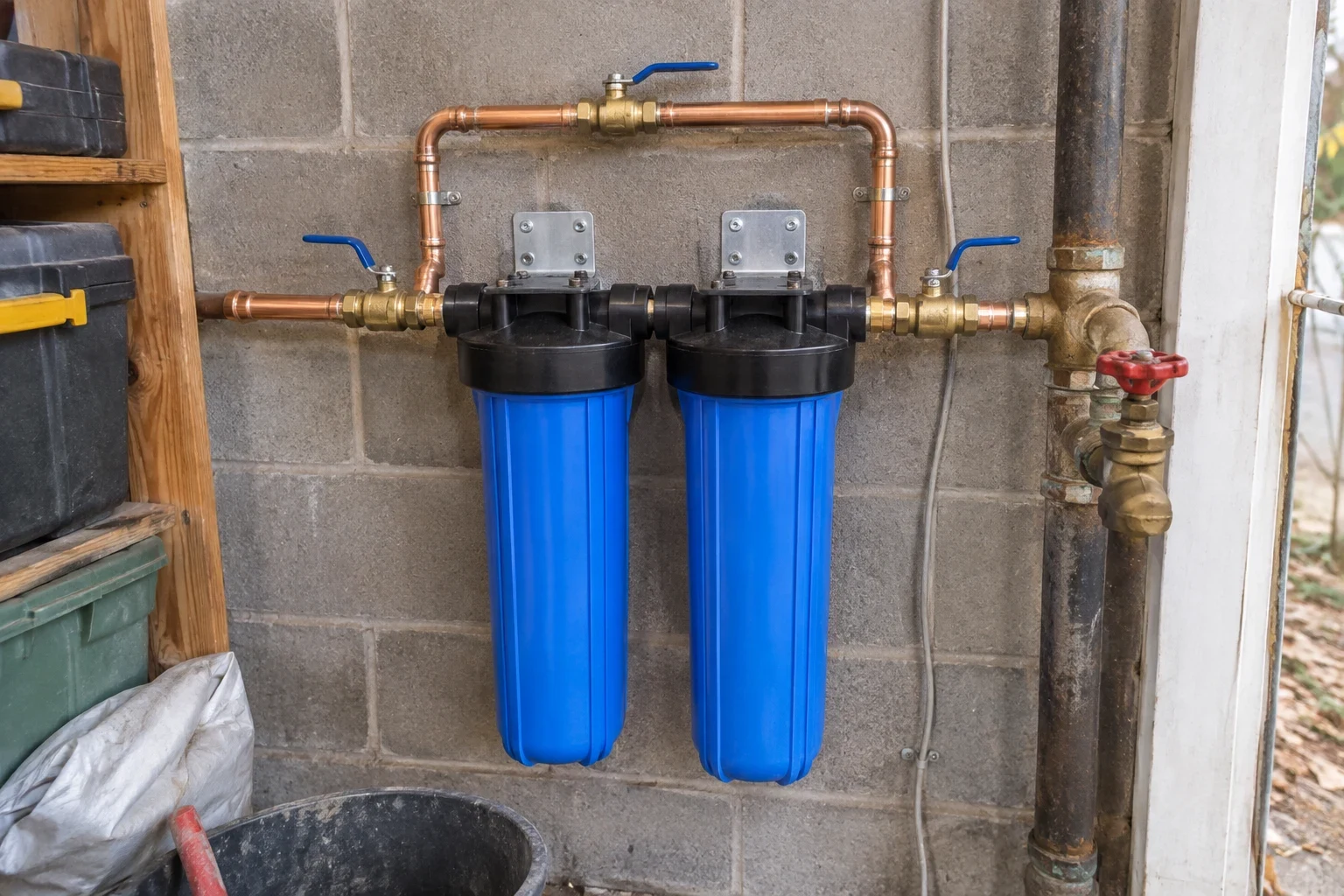
Point-of-entry filtration is installed on the main supply just past the shutoff valve and ahead of the water heater. Incoming water runs through a sediment stage first, then through carbon or a specialty media, and only then splits off to the rest of the plumbing. Because of that location, your water heater, dishwasher and showers all receive the same filtered water as the kitchen faucet.
This is the right choice when the trouble appears at every tap, like a chlorine odor in each shower or grit collecting in every aerator. If drinking water is your only concern, an under-sink unit might cover it, and we will tell you that. Middle Tennessee sits on limestone, so supply water often carries calcium and magnesium. We test hardness as well, since carbon does nothing for scale and some homes need a softener paired with the filter.
Safe installation drives how we do the job: a system sized to your flow, a bypass so filters can be changed without draining the house, electrical grounding restored across the new section and media rated for drinking water contact.
What the installation includes
- Water testing before we quote
- On site we measure hardness, chlorine or chloramine, iron and sediment. Homes on a private well should also get a lab test for bacteria and nitrates before anyone picks equipment.
- Sizing to your flow rate
- We tally bathrooms and fixtures to estimate peak demand in gallons per minute. A tank or housing that is too small shows up as a pressure drop the moment two showers run together.
- Three-valve bypass loop
- Shutoff valves on the inlet and outlet plus a bypass keep water flowing to the house while cartridges are swapped or media is serviced. Routine maintenance never requires turning off the main.
- Grounding jumper on metal pipe
- Copper water lines often serve as part of the electrical grounding path. Splicing in plastic filter housings can interrupt that path, so we bond across the new section with a jumper.
- Rated media and lead-free fittings
- Cartridges and media we install are tested to NSF/ANSI standards for drinking water contact, connected with lead-free brass. Backwashing tanks drain through an air gap so wastewater cannot be pulled back into the supply.
- Startup, flush and walkthrough
- We rinse loose carbon fines out of the new media, check every joint under line pressure and point out the bypass and shutoff valves before we go.
Signs your home could use whole home filtration
Chlorine smell in the shower
Disinfectant is necessary in city water, but some people find the odor and dry skin unpleasant. Catalytic carbon removes chlorine and chloramine before the water reaches any fixture.
White crust on fixtures
Scale on showerheads and glass points to hard water. Scale also builds up inside water heaters and tankless heat exchangers, cutting efficiency.
Grit or cloudy water
Sediment after utility work or from a well clogs aerators and wears out valve cartridges. A sediment prefilter catches it at the entry point.
Orange or brown stains
Iron and manganese leave stains in toilets and laundry. These need specific media, so testing comes before any purchase.
Rotten egg odor
A sulfur smell on hot water only often points to the water heater anode. On both hot and cold, it is usually in the supply, and filtration can address it.
What moves the price
The estimate costs you nothing, and it lists equipment and labor on separate lines so each part is clear. Two things drive most of the number: what the water test turns up and how much water your home pulls at peak. We offer financing options, and you can pay with cash or any major credit card.
What needs removing
Sediment plus carbon is the simplest setup. Adding iron, sulfur or hardness treatment can mean an extra stage or a second tank, and each one adds equipment and plumbing.
Household flow demand
A house with four bathrooms draws far more gallons per minute than one with two. Higher peak flow calls for bigger housings or tanks so pressure holds steady.
Cartridge versus backwashing tank
Cartridge housings are cheaper to install but need regular replacements. A backwashing tank costs more on day one, needs a drain line and an outlet, and goes much longer between service visits.
Access to the main line
An open run of pipe beside the shutoff in a garage is quick work. A main hidden behind finished drywall or tucked into a low crawlspace takes more labor to reach and protect.
How the job runs on installation day
- 1
Confirm location and clearance
We pick a spot near the main shutoff with room for cartridge changes, a nearby drain if needed and protection from freezing. Garages and crawlspace entries both work with the right insulation.
- 2
Shut off and depressurize
We close the main, open a low faucet to relieve pressure and protect the floor before cutting into the line.
- 3
Install the system and bypass
We set the housings or tanks, plumb the bypass loop, add the bonding jumper if the pipe is metal and run any drain line with an air gap.
- 4
Pressure test and flush
Water goes back on slowly to push air out. We check every connection, flush the media and confirm pressure at the farthest fixture before we leave.
Whole home filtration questions
Will filtering all my water make the shower weaker?
Not if the system matches your home's demand. Pressure loss usually traces back to housings that are too small for the flow, or cartridges that stayed in long after they clogged. We size from your peak gallons per minute and tell you when each filter is due.
How often do filters need changing?
Sediment cartridges often need replacing every few months, sooner if the water carries a lot of grit. Carbon cartridges run longer, and the media in a backwashing tank can last for years. You get a change schedule built from your test results and how much water your household uses.
Is this the same as a water softener?
No. Carbon handles chlorine, taste and odor, while a softener swaps out calcium and magnesium so scale stops forming. Plenty of homes need both, and the order they sit on the line matters, so we plumb them in the correct sequence.
Does it remove lead?
Only some whole home media is rated by NSF/ANSI for lead reduction, and many standard carbon systems are not. If lead worries you, we check the rating on the exact product before installing it, or we suggest a lead-rated filter at the kitchen tap where you draw drinking water.
Can it go outside?
Yes, inside an insulated enclosure with freeze protection. A housing that cracks during a hard freeze can dump water until someone shuts the main. If there is space near the shutoff indoors, that is usually where we recommend putting it.
Find out what is actually in your water
We will test your water, look at where the line enters your home and explain which system fits. If something fails after hours, our 24/7 emergency plumbing service is on the same line.